
Have you ever wondered why some countries still use capital punishment while others have banned it? Capital punishment, also called the death penalty, is when the government gives the most serious punishment—death—to someone found guilty of a terrible crime, like murder. It’s a topic that makes people think deeply about justice, fairness, and forgiveness. In this article, we will learn how to write an essay about capital punishment in a simple and easy way for students.
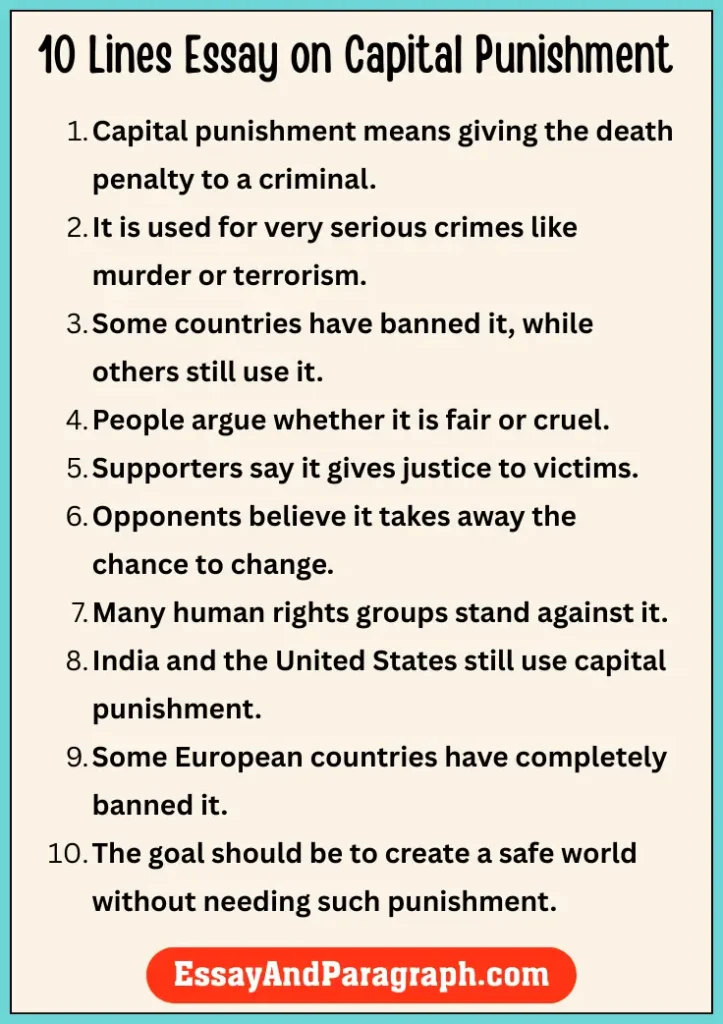
10 Lines Essay on Capital Punishment
Capital punishment means giving the death penalty to a criminal.
It is used for very serious crimes like murder or terrorism.
Some countries have banned it, while others still use it.
People argue whether it is fair or cruel.
Supporters say it gives justice to victims.
Opponents believe it takes away the chance to change.
Many human rights groups stand against it.
India and the United States still use capital punishment.
Some European countries have completely banned it.
The goal should be to create a safe world without needing such punishment.
Essay on Capital Punishment – 100 Words
Capital punishment, also known as the death penalty, is a serious form of punishment where a person is put to death by the state for committing very serious crimes. Some countries, like India and China, still practice it, while others, like the United Kingdom, have stopped it. People who support capital punishment believe it helps stop crime and gives justice to victims. Those against it think it is cruel and unfair. Capital punishment is a very serious topic that raises questions about law, justice, and humanity. We must always find ways to make the world safer without using violence.
Essay on Capital Punishment – 150 Words
Capital punishment, also known as the death penalty, is a legal process where a person is executed for committing serious crimes such as murder or terrorism. It has been practiced for centuries and continues in some countries like India, China, and the United States. However, many nations, including the United Kingdom and France, have abolished it, calling it inhumane and unjust. Supporters believe it provides justice and helps deter crime, while opponents argue that it violates human rights and may lead to wrongful executions. According to global reports, over two-thirds of countries have ended the death penalty in law or practice. The debate continues between justice and mercy. Rather than ending lives, society should focus on fair trials, rehabilitation, and preventing crime through education and social reform. True justice should aim to build a safer, kinder, and more compassionate world for everyone.
Essay on Capital Punishment – 200 Words
Capital punishment is one of the oldest forms of punishment in the world. It means that a person who commits a very serious crime, like murder or terrorism, is sentenced to death by the court. The purpose is to make sure others are scared to do similar crimes. However, many people question whether it is the right thing to do.
Some countries, like the United States, China, and India, still use capital punishment. Others, such as Canada and Australia, have banned it. According to the United Nations, more than two-thirds of the world’s countries have abolished the death penalty in law or practice.
Those who support capital punishment say it provides justice for victims and keeps society safe. But those who oppose it believe every person has a right to live and can change for the better. It can also be unfair if someone innocent is punished.
Capital punishment raises deep moral questions about justice, forgiveness, and human life. Instead of ending lives, society should focus on reforming criminals and creating better education and law systems to prevent crime.
Short Essay on Capital Punishment – 250 Words
Capital punishment, also called the death penalty, is one of the most debated topics in modern society. It is a punishment where a person found guilty of a grave crime, such as murder or terrorism, is executed by the government.
In many countries, capital punishment has been used for centuries to maintain law and order. For example, India still allows it in rare cases, while more than 70% of countries, including France and Germany, have banned it. According to Amnesty International, over 50 countries continue to practice it.
Supporters say capital punishment gives justice to victims and prevents other people from committing crimes. They believe fear of death can reduce serious crimes. However, critics argue that it goes against human rights and that mistakes in judgment can lead to the death of innocent people.
Every year, reports show that some people sentenced to death were later found innocent. This raises the question of whether such punishment should exist.
In the end, the main goal of justice should not be revenge but to reform individuals and protect society. Capital punishment may bring temporary justice, but forgiveness and education build a more peaceful future.
Long Essay on Capital Punishment – 500 Words
Capital punishment, or the death penalty, is the legal process where a person is executed by the government as a punishment for a crime. It is usually given for crimes like murder, terrorism, or treason. This topic has been debated for centuries, as it involves questions about justice, morality, and human rights.
Capital punishment has been used since ancient times. In early civilizations like Greece, Rome, and Egypt, it was a common way to punish serious crimes. Today, some countries, including the United States, China, and India, still use it, while others, such as France, Italy, and Canada, have completely abolished it. According to a 2024 report by Amnesty International, more than 112 countries have ended capital punishment in law or practice.
Supporters believe that capital punishment ensures justice for victims and acts as a strong warning to others. For example, in India, it is used only in “the rarest of rare” cases, such as terrorism or brutal murder. They argue that some crimes are so severe that no other punishment can provide justice.
However, opponents say that the death penalty goes against human rights. Once someone is executed, there is no way to fix a mistake if the person was innocent. Studies show that errors in court judgments are not uncommon. For instance, the United States has released more than 190 people from death row after new evidence proved them innocent.
There is also the moral argument. Many believe life should not be taken, no matter the crime. Religion and ethics teach that forgiveness and reform are better than revenge. Killing a criminal does not bring back the victim but may cause more pain for families.
In modern times, more nations are moving toward life imprisonment instead of execution. This allows time for rehabilitation and prevents wrongful deaths. Capital punishment might look like justice, but it can often lead to more harm than good.
To conclude, capital punishment remains one of the world’s most difficult and emotional debates. Justice systems must focus on fairness, reform, and humanity. True justice should aim to change lives, not end them.
FAQs on Essay on Capital Punishment
1. What is capital punishment?
Capital punishment, also known as the death penalty, is a punishment where the government executes someone for committing a very serious crime. These crimes often include murder, terrorism, or treason. It has been used for thousands of years, but today many countries have banned it. People debate whether it is right or wrong, as it raises moral and human rights questions. Some believe it gives justice to victims, while others think it is cruel and irreversible.
2. Which countries still have capital punishment?
Many countries still use capital punishment, such as China, India, Japan, and the United States. According to Wikipedia, China executes more people each year than any other nation. In contrast, many European countries, including France and Germany, have completely banned it. Around 55 countries in total still allow it by law, but not all actively use it.
3. Why do people support capital punishment?
Supporters of capital punishment believe it deters people from committing crimes. They argue it ensures justice for victims and shows that serious crimes have serious consequences. Some also think it helps bring peace to victims’ families. However, many experts say there is no clear proof that it actually reduces crime rates.
4. Why do people oppose capital punishment?
People who oppose the death penalty say it violates the right to life. They believe everyone should have a chance to change, even those who did wrong. Sometimes innocent people are punished due to mistakes in court. Critics also say killing someone does not teach society compassion or forgiveness.
5. How can we make justice fair without using capital punishment?
Justice can be fair through life imprisonment, rehabilitation, and education programs. Instead of ending a life, we can help offenders understand their actions and become better people. Building strong laws, improving police work, and focusing on fairness can reduce crime more effectively than the death penalty.
Top 5 Quotes on Capital Punishment
“An eye for an eye makes the whole world blind.” – Mahatma Gandhi
“To take a life when a life has been lost is revenge, not justice.” – Desmond Tutu
“Capital punishment is the most premeditated of murders.” – Albert Camus
“The death penalty is a sign of the weakness, not the strength, of a society.” – Coretta Scott King
“Justice cannot be for one side alone, but must be for both.” – Eleanor Roosevelt
Summary on Essay on Capital Punishment
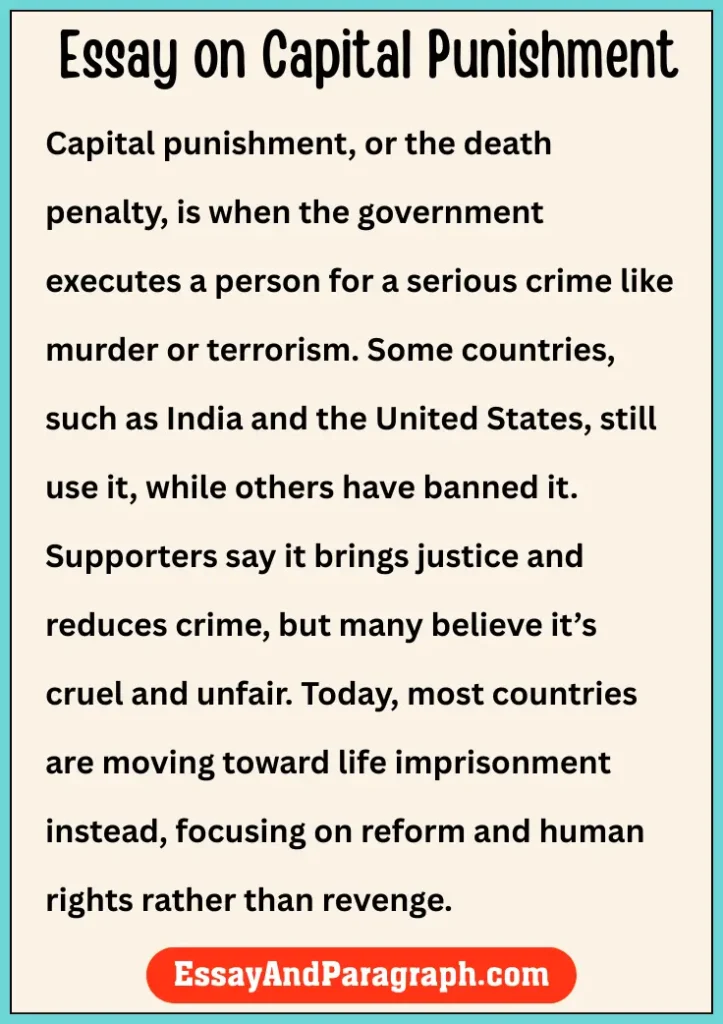
Capital punishment, or the death penalty, is when the government executes a person for a serious crime like murder or terrorism. Some countries, such as India and the United States, still use it, while others have banned it. Supporters say it brings justice and reduces crime, but many believe it’s cruel and unfair. Today, most countries are moving toward life imprisonment instead, focusing on reform and human rights rather than revenge.